Generate Private Key For Signature Java
- Generate Private Key For Signature Java Download
- Generate Private Key For Signature Java Software
- Generate Private Key For Signature Java Version
- Generate Private Key For Signature Java Download
- Generate Private Key For Signature Java Free
- Generate Private Key For Signature Java Free
Mar 29, 2016 This tutorial explains how to create a public private keystore for client and server. You can use these keystores to secure communication between client and server. Home » Java » Create Public Private KeyStore for Client and Server. Execute the following command in a terminal. This command generates a 2048-bit RSA key pair. Generate a Public-Private Key Pair. There are several ways to generate a Public-Private Key Pair depending on your platform. In this example, we will create a pair using Java. The Cryptographic Algorithm we will use in this example is RSA. In that case the program can import and use the private key for signing, as shown in Weaknesses and Alternatives. In other cases the program needs to generate the key pair. A key pair is generated by using the KeyPairGenerator class. In this example you will generate a public/private key pair for the Digital Signature Algorithm (DSA). Jan 24, 2017 Learn how to generate and use RSA public and private keys in Java. Save in PKCS#8 and X.509 formats. Use for digital signature verification.
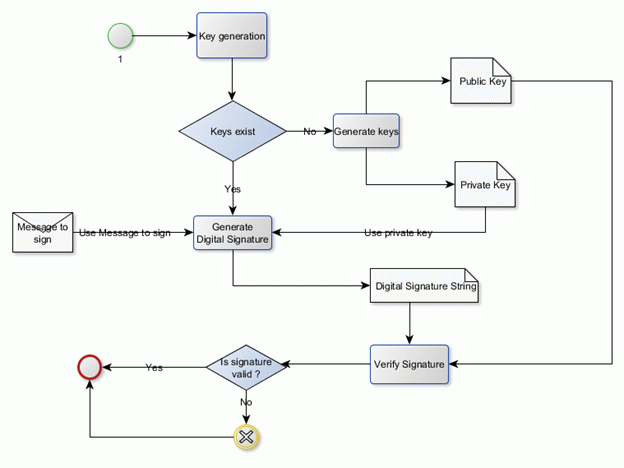
Nov 01, 2018 A private key can be use to sign a document and the public key is use to verify that the signature of the document is valid. The API we use to generate the key pairs is in the java.security package. That’s mean we have to import this package into our code. The class for generating the key pairs is KeyPairGenerator. In this example you will generate a public/private key pair for the Digital Signature Algorithm (DSA). You will generate keys with a 1024-bit length. Generating a key pair requires several steps: Create a Key Pair Generator. The first step is to get a key-pair generator object for generating keys for the DSA signature. May 28, 2019 But for the signing process we’ll only use the private key. While the public key will be use to verify the signature. To create a digital signature we need an instance of java.security.Signature. To get one we can call the Signature.getInstance method.
In order to be able to create a digital signature, you need a private key. (Its corresponding public key will be needed in order to verify the authenticity of the signature.)
In some cases the key pair (private key and corresponding public key) are already available in files. In that case the program can import and use the private key for signing, as shown in Weaknesses and Alternatives.
In other cases the program needs to generate the key pair. A key pair is generated by using the KeyPairGenerator class.
In this example you will generate a public/private key pair for the Digital Signature Algorithm (DSA). You will generate keys with a 1024-bit length.
Generating a key pair requires several steps:
Create a Key Pair Generator
The first step is to get a key-pair generator object for generating keys for the DSA signature algorithm.
As with all engine classes, the way to get a KeyPairGenerator object for a particular type of algorithm is to call the getInstance static factory method on the KeyPairGenerator class. This method has two forms, both of which hava a String algorithm first argument; one form also has a String provider second argument.
A caller may thus optionally specify the name of a provider, which will guarantee that the implementation of the algorithm requested is from the named provider. The sample code of this lesson always specifies the default SUN provider built into the JDK.
Put the following statement after the
line in the file created in the previous step, Prepare Initial Program Structure:
Initialize the Key Pair Generator
The next step is to initialize the key pair generator. All key pair generators share the concepts of a keysize and a source of randomness. The KeyPairGenerator class has an initialize method that takes these two types of arguments.
The keysize for a DSA key generator is the key length (in bits), which you will set to 1024.
The source of randomness must be an instance of the SecureRandom class that provides a cryptographically strong random number generator (RNG). For more information about SecureRandom, see the SecureRandom API Specification and the Java Cryptography Architecture Reference Guide .
The following example requests an instance of SecureRandom that uses the SHA1PRNG algorithm, as provided by the built-in SUN provider. The example then passes this SecureRandom instance to the key-pair generator initialization method.
Some situations require strong random values, such as when creating high-value and long-lived secrets like RSA public and private keys. To help guide applications in selecting a suitable strong SecureRandom implementation, starting from JDK 8 Java distributions include a list of known strong SecureRandom implementations in the securerandom.strongAlgorithms property of the java.security.Security class. When you are creating such data, you should consider using SecureRandom.getInstanceStrong(), as it obtains an instance of the known strong algorithms.
Generate the Pair of Keys
The final step is to generate the key pair and to store the keys in PrivateKey and PublicKey objects.
2018-06-11T14:15:42Z
JSON Web Tokens offer a simple and powerful way to generate tokens for APIs. These tokens carry a payload that is cryptographically signed. While the payload itself is not encrypted, the signature protects it again tampering. In their most common format, a 'secret key' is used in the generation and verification of the signature. In this article I'm going to show you a less known mechanism to generate JWTs that have signatures that can be verified without having access to the secret key.
Quick Introduction to JSON Web Tokens (JWTs)
In case you are not familiar with JWTs, let me first show you how to work with them using Python with the pyjwt package. Create a virtual environment, and install pyjwt in it:
Now let's say you want to create a token that gives a user with id 123 access to your application. After you verify that the user has provided the correct username and password, you can generate a token for the user:
Generate Private Key For Signature Java Download
The jwt.encode() function has three arguments of which the most important is the first, containing the token payload. This is the information that you want stored in the token. You can use anything that can be serialized to a JSON dictionary as a payload. The payload is where you record any information that identifies the user. In the simplest case this is just the user id like in the example above, but you can include other user information such as a username, user roles, permissions, etc. Here is a more complex token:
As you can see, the more data you write in the payload, the longer the token is, because all that data is physically stored in the token. By looking at the resulting JWTs you may think that the data that you put in the tokens is encrypted, but this is actually incorrect. You should never write sensitive data in a JWT, because there is no encryption. This seemingly random sequence of characters that you see in these tokens is just generated with a simple base64 encoding.
In addition to user information, the payload of a JWT can include a few fields that apply to the token itself, and have a predefined meaning. The most useful of these is the exp field, which defines an expiration time for the token. The following example gives the token a validity period of 5 minutes (300 seconds):
Other predefined fields that can be included in the JWT are nbf (not before), which defines a point in time in the future at which the token becomes valid, iss (issuer), aud (audience) and iat (issued at). Consult the JWT specification if you want to learn more about these.
The second argument to jwt.encode() is the secret key. This is a string that is used in the algorithm that generates the cryptographic signature for the token. The idea is that this key must be known only to the application, because anyone who is in possession of this key can generate new tokens with valid signatures. In a Flask or Django application, you can pass the configured SECRET_KEY for this argument.
The last argument in the jwt.encode() call is the signing algorithm. Most applications use the HS256 algorithm, which is short for HMAC-SHA256. The signing algorithm is what protects the payload of the JWT against tampering.
The value returned by jwt.encode() is a byte sequence with the token. You can see in all the above examples that I decoded the token into a UTF-8 string, because a string is easier to handle.
Once your application generates a token it must return it to the user, and from then on, the user can authenticate by passing the token back to the server, which prevents the user from having to constantly send stronger credentials such as username and password. Using JWTs for authentication is considered more secure than usernames and passwords, because you can set an appropriate expiration time, and in that way limit the damage that can be caused in the case of a leak.
When the application receives a JWT from the user it needs to make sure that it is a legitimate token that was generated by the application itself, which requires generating a new signature for the payload and making sure it matches the signature included with the token. Using the first of the example tokens above, this is how the verification step is done with pyjwt:
The jwt.decode() call also takes three arguments: the JWT token, the signing key, and the accepted signature algorithms. Note how in this call a list of algorithms is provided, since the application may want to accept tokens generated with more than one signing algorithm. Note that while the algorithms argument is currently optional in pyjwt, there are potential vulnerabilities that can occur if you don't pass the list of algorithms explicitly. If you have applications that call jwt.decode() and don't pass this argument, I strongly advise you to add this argument.
The return value of the jwt.decode() call is the payload that is stored in the token as a dictionary ready to be used. If this function returns, it means that the token was determined to be valid, so the information in the payload can be trusted as legitimate.
Let's try to decode the token from above that had an associated expiration time. I have generated that token more than five minutes ago, so even though it is a valid token, it is now rejected because it has expired:
It is also interesting to see what happens if I take one of the tokens above, make a change to any of the characters in the string and then try to decode it:
download htc sync manager mac So as you see, if jwt.decode() returns back a dictionary, you can be sure that the data in that dictionary is legitimate and can be trusted (at least as much as you are sure your secret key is really secret).
Using Public-Key Signatures with JWTs
A disadvantage of the popular HS256 signing algorithm is that the secret key needs to be accessible both when generating and validating tokens. For a monolithic application this isn't so much of a problem, but if you have a distributed system built out of multiple services running independently of each other, you basically have to choose between two really bad options:
- You can opt to have a dedicated service for token generation and verification. Any services that receive a token from a client need to make a call into the authentication service to have the token verified. For busy systems this creates a performance bottleneck on the authentication service.
- You can configure the secret key into all the services that receive tokens from clients, so that they can verify the tokens without having to make a call to the authentication service. But having the secret key in multiple locations increases the risk of it being compromised, and once it is compromised the attacker can generate valid tokens and impersonate any user in the system.
So for these types of applications, it would be better to have the signing key safely stored in the authentication service, and only used to generate keys, while all other services can verify those tokens without actually having access to the key. And this can actually be accomplished with public-key cryptography.
Public-key cryptography is based on encryption keys that have two components: a public key and a private key. As it name imples, the public key component can be shared freely. There are two workflows that can be accomplished with public-key cryptography:
- Message encryption: If I want to send an encrypted message to someone, I can use that person's public key to encrypt it. The encrypted message can only be decrypted with the person's private key.
- Message signing: If I want to sign a message to certify that it came from me, I can generate a signature with my own private key. Anybody interested in verifying the message can use my public key to confirm that the signature is valid.
There are signing algorithms for JWTs that implement the second scenario above. Tokens are signed with the server's private key, and then they can be verified by anyone using the server's public key, which is freely available to anyone who wants to have it. For the examples that follow I'm going to use the RS256 signing algorithm, which is short for RSA-SHA256.
The pyjwt package does not directly implement the cryptographic signing functions for the more advanced public-key signing algorithms, and instead depends on the cryptography package to provide those. So to use public-key signatures, this package needs to be installed:
The next step is to generate a public/private key set (usually called a 'key pair') for the application to use. There are a few different ways to generate RSA keys, but one that I like is to use the ssh-keygen tool from openssh:
The -t option to the ssh-keygen command defines that I'm requesting an RSA key pair, and the -b option specifies a key size of 4096 bits, which is considered a very secure key length. When you run the command you will be prompted to provide a filename for the key pair, and for this I used jwt-key without any path, so that the key is written to the current directory. Then you will be prompted to enter a passphrase to protect the key, which needs to be left empty.
When the command completes, you are left with two files in the current directory, jwt-key and jwt-key.pub. The former is the private key, which will be used to generate token signature, so you should protect this very well. In particular, you should not commit your private key to your source control, and instead should install on your server directly (you should keep a well protected backup copy of it, in case you ever need to rebuild your server). The .pub file will be used to verify tokens. Since this file has no sensitive information, you can freely add a copy of it on any project that needs to verify tokens.
The process to generate tokens with this key pair is fairly similar to what I showed you earlier. Let's first make a new token:

The main difference with the previous tokens is that I'm passing the RSA private key as the secret key argument. The value of this key is the entire contents of the jwt-key file. The other difference is that the algorithm requested is RS256 instead of HS256. The resulting token is longer, but otherwise similar to those I generated previously. Like the previous tokens, the payload is not encrypted, so also for these tokens you should never put sensitive information in the payload.
Now that I have the token, I can show you how it can be verified using the public key. If you are trying this with me, exit your Python session and start a new one, to make sure there is no trace of the private key in the Python context. Here is how you can verify the token above:
This example looks nearly identical to the previous ones, but the important fact is that we are ensuring this token is valid without access to any sensitive information. The server's public key presents no risk, so it can be freely shared with the world. And in fact, anybody would be able to verify the tokens that your application generates with this key. To prove this point, let me share with you my public key:
You can now take this public key and validate the token that I generated, and letting you validate the tokens does not introduce any security risks for me. I'm still the only person in the world that can generate new tokens.
Conclusion
I hope those of you who were using JWTs with the popular HS256 algorithm are now ready to introduce RS256 or any of the other public-key signature options available.
Generate Private Key For Signature Java Software
Let me know if you have any questions in the comment area below!
Generate Private Key For Signature Java Version
Hello, and thank you for visiting my blog! If you enjoyed this article, please consider supporting my work on this blog on Patreon!
Generate Private Key For Signature Java Download
41 comments
Generate Private Key For Signature Java Free
#1Ars said 2018-06-11T19:42:22Z
#2Miguel Grinberg said 2018-06-11T22:34:20Z
#3JM said 2018-07-06T00:47:09Z
#4Miguel Grinberg said 2018-07-06T05:37:07Z
#5Abdul Wahab van Reenen said 2018-07-30T10:21:35Z
#6Miguel Grinberg said 2018-07-30T21:02:35Z
#7SG said 2018-08-07T00:35:35Z
#8Miguel Grinberg said 2018-08-07T21:18:10Z
#9Mitch said 2018-08-19T22:08:06Z
#10stm said 2018-09-07T07:24:16Z
#11Miguel Grinberg said 2018-09-13T20:51:35Z
#12grex_e said 2018-10-17T23:52:59Z
#13Miguel Grinberg said 2018-10-18T14:19:33Z
#14grex_e said 2018-10-20T23:40:32Z
#15Vladyslav said 2018-11-01T09:58:18Z
#16yoni said 2018-11-10T00:18:03Z
#17Akshay said 2018-12-11T21:12:23Z
#18Miguel Grinberg said 2018-12-12T15:21:26Z
#19simi403 said 2018-12-19T18:24:52Z
#20Miguel Grinberg said 2018-12-19T22:19:59Z
#21Kim said 2019-02-24T00:28:17Z
#22Miguel Grinberg said 2019-02-24T19:47:17Z
#23Saqib said 2019-04-12T10:10:24Z
#24Miguel Grinberg said 2019-04-12T18:34:58Z
#25Andy said 2019-08-17T13:19:30Z